
40 Touch-and-Goes a Day, and a Rule Nobody Has to Follow
Flight schools from Jacksonville use Fernandina Beach Municipal Airport as a free practice runway. The city's only limit is a voluntary request, and its own records show it isn't working.
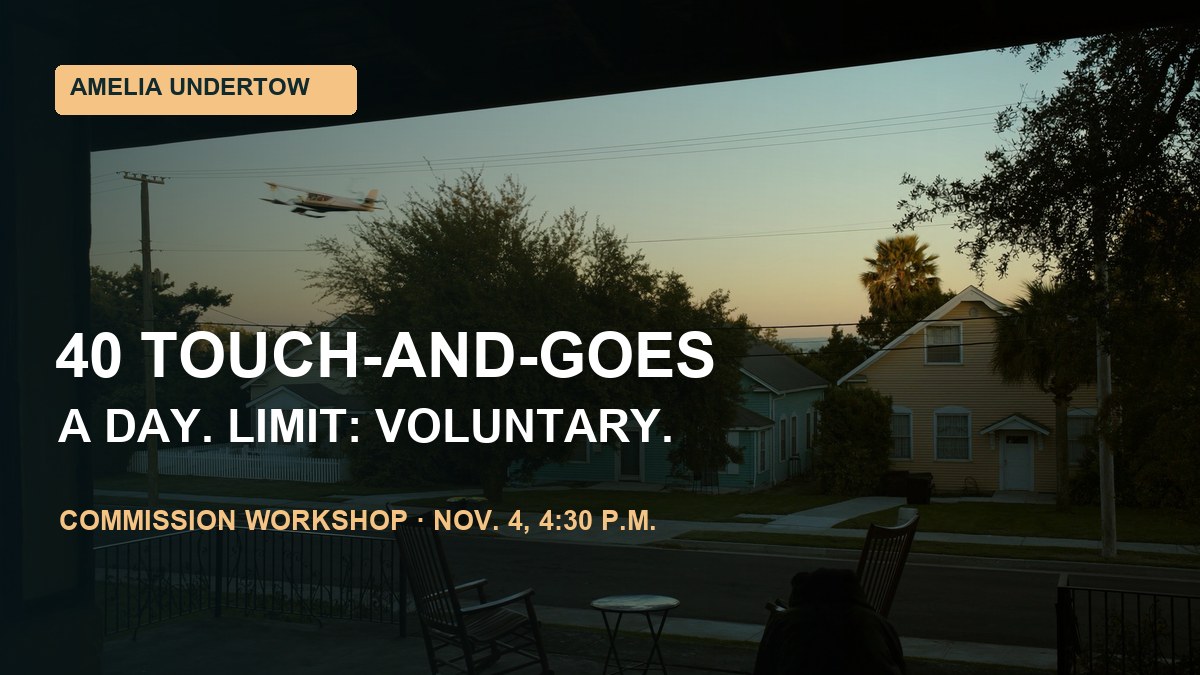
The City Commission holds an airport noise workshop on Wednesday, November 4, at 4:30 p.m. Commissioners will take up airport noise at a dedicated session, after years of complaints and a "five touch-and-goes" guideline that pilots are free to ignore. City calendar
A touch-and-go is exactly what it sounds like. A training plane lands, keeps rolling, throttles up and takes off again without stopping, then flies a rectangle around the airport and does it again. Each loop takes a few minutes, and each one sends a single-engine piston airplane low over the same homes at full climb power.
At Fernandina Beach Municipal Airport, that happened 14,748 times in the 12 months ending September 30, 2025, or about 40 a day. The count comes from the airport's VirTower tracking system, which detects a touch-and-go when an aircraft touches the runway and climbs out again without stopping or exiting. The Fernandina Observer obtained and analyzed the data (the Observer says it used AI tools to process the 12 months of records). The same data shows 52,537 total runway operations in that year, so touch-and-goes were roughly 28 percent of all runway activity. Cessna 172s, the standard flight-school trainer, logged more than 29,000 operations.
The guideline says five. The record says otherwise.
The city's posted noise abatement guidelines ask pilots for "no more than five (5) touch & go's without departing the pattern." They also ask pilots to avoid flying between 10 p.m. and 7 a.m., minimize overflight of noise-sensitive areas, climb to 800 feet over water before turning, and use Runway 22, which the airport says creates the least noise impact, when the wind allows.
Every one of those items is a request. The city's own FAQ says it plainly: the guidelines "are voluntary and no penalties can be imposed upon aircraft operators for not following" them. City airport FAQ Airport Manager Nathan Coyle put it the same way: "We ask pilots to voluntarily comply with those guidelines, but we have no enforcement powers." Fernandina Observer
The documented examples run well past five:
- An Atlas Aviation Cessna completed 14 touch-and-goes in a one-hour flight, according to tracking data published by the Observer. Fernandina Observer, May 23, 2026
- A Crane Island couple told the city they have counted 27 to 30 repeated takeoffs and landings by the same training aircraft. "At times, we cannot even sit outside on our porch," they wrote. Master plan public comments, via the Fernandina Observer
- A Parkway North resident counted 20 takeoffs in one hour on Runway 13. Fernandina Observer
Two days after the city manager told commissioners the city was stepping up its response, on Thursday, May 21, two Aerosim Academy Cessnas were back in the pattern by about 7:15 a.m., according to flight-tracking data the Observer reviewed. One flew looping approaches as low as 200 feet. Fernandina Observer
Who is flying, and who pays
Most of the repetitive training comes from flight schools based at Jacksonville Executive at Craig Airport, including ATP Flight Academy and Aerosim, according to the Observer's reporting. Fernandina has no control tower. FAA airport record via AirNav Its pattern is uncongested, which makes it an attractive place to practice. As one resident told the Observer, the pilots "fly in, they make their 10 or 15 loops and they fly back to Craig."
A visiting training flight that never stops pays the city nothing. Fernandina does not charge landing fees (a 2024 proposal to start was shelved, below), and a plane that touches and goes doesn't park, buy fuel or use a hangar. In 2024 the Observer reported that the flight schools "generate no income for the city." Fernandina Observer, April 2024 We found no city financial record showing otherwise, and none was submitted during the master plan comment period. Fernandina Observer
What's typical, and what the FAA allows
Touch-and-goes are normal. They are how student pilots learn the most demanding parts of flying, and most pilots learn to land this way. The airport was handed to the city in 1946 and is a designated reliever airport for Jacksonville International. Airport history Flight schools point to a national pilot shortage, and the airport manager cites a $219 million annual economic impact for the airport as a whole. Fernandina Observer Not everyone near the field objects: one owner of three homes on South Fletcher Avenue wrote that the noise doesn't bother him. Fernandina Observer
Voluntary programs are also normal. Because the airport takes federal money, it signed the FAA's grant assurances, which require it to stay open to every type of aeronautical user on reasonable, non-discriminatory terms. The city says that is why it "cannot restrict access to certain types of aircraft operations nor impose mandatory curfews." City noise page
But "voluntary forever" is not what federal rules require. The FAA's airport compliance manual says a touch-and-go "cannot be restricted by the airport sponsor without justification." An airport can limit touch-and-goes if the limit is based on an analysis of safety, efficiency or capacity and meets federal noise and access rules. The same chapter lists accommodation measures such as restricted times, prior notification and caps on the number of operations. FAA Order 5190.6C, Chapter 14 The FAA itself banned touch-and-goes at Denver's busy Centennial Airport in October 2026, citing conflicts between departing traffic. AVweb
The catch is the word "justification." Florida has already seen what happens without it. In 2005 the FAA found Pompano Beach's limits on touch-and-goes and other training unreasonable, largely because the city had not backed them with a Part 150, Part 161 or comparable study. Kaplan Kirsch, Airport Law Alert No. 3 The lesson is not that cities can do nothing. It is that a city has to do the study first.
What the city has done
- 2024: a landing fee, shelved. The airport director floated an automated landing fee program estimated to raise as much as $200,000 a year, which supporters said would also discourage repetitive training. The airport's fixed-base operator opposed it, and it went nowhere. Fernandina Observer
- That tool is now partly closed. Since July 1, 2026, Florida law bars airports from using ADS-B tracking data to bill landing fees, including for touch-and-goes, for aircraft of 12,499 pounds or less. The law does not ban landing fees themselves. Florida Senate analysis, SB 422
- May 2026: letters and meetings. City Manager Sarah Campbell told commissioners on May 19 that the city met with four Jacksonville flight schools and the Crane Island homeowners, and that "each week, if somebody is violating the noise abatement guidelines, that flight school is receiving a notice from the city." The city has not published how many notices went out, to whom, or whether anything changed. Fernandina Observer
- 2026: the master plan. The FAA-required master plan update, which sets airport development for the next 20 years, drew at least 323 public survey responses early in the process. Noise and touch-and-go training were the top concerns. "Without a doubt, it's noise and it's limiting flight schools and touch-and-go activity," Ryan Allen said while presenting the survey summary at the plan's first technical meeting. Fernandina Observer The October 24 open house produced about 45 pages of written comments. The master plan will map current and projected noise exposure, but specific noise-reduction recommendations would require a separate study. Fernandina Observer
Why it should change
Noise from flight-school training has been before city advisory boards since at least 2022, and the city's approach has been to ask. During that time, a single trainer has flown 14 touch-and-goes in an hour against a posted guideline of five, and residents have counted 30. The city receives "one or two" noise complaints a week, and the people filing them get no remedy. The schools creating the problem pay nothing to use a runway that taxpayers and federal grants maintain.
The city's standard answer, that the FAA won't let it act, is half true. The FAA won't let a city act on complaints alone. It does let a city act on a study. We found no record that the city has commissioned one, and its master plan has expressly left noise-reduction recommendations to a study that doesn't yet exist.
The Fix
- Commission a Part 150 noise study now, separate from the master plan. It is the FAA's own process for documenting noise impacts and proposing measures, and it is the evidence the FAA said Pompano Beach lacked. Without it, every other fix on this list can be challenged.
- Use the study to seek FAA-approved limits, not just requests. The FAA's manual names the tools: restricted times, prior notification and caps on operations. Residents have already drafted reasonable targets: repetitive training only from 9 a.m. to 5 p.m. on weekdays, no more than five touch-and-goes per visit, and no more than three training aircraft in the pattern at once. Resident proposals
- Revisit a landing fee, collected without ADS-B. State law now blocks billing from ADS-B data, not fees. A fee applied evenly to every itinerant landing, counted by cameras or attendants, set to recover real runway costs and cleared with the FAA's rates-and-charges rules, would make a 14-loop lesson cost something. One limit: state law exempts flight training by accredited nonprofit institutions with four-year aviation programs. Florida Senate analysis
- Put the flight schools on paper. Replace weekly warning letters with written agreements with each Jacksonville school that set training hours, a per-visit cap and preferred patterns. Then publish each school's monthly compliance.
- Publish the data the city already has. The airport's tracking system counts every touch-and-go. A monthly public report of touch-and-goes by hour, runway and operator, plus the complaint log, would show residents whether anything is working and show the FAA the pattern a study needs.
- Give neighbors a seat. Add a non-aviation resident to the master plan's technical advisory committee, or create a standing noise roundtable, as residents asked in their comments.
What you can do
- Attend or watch the November 4, 4:30 p.m. commission workshop, or email commissioners before it.
- Log every event. Use the city's airport noise concern form and the FAA Noise Portal, and include the time, the direction of flight and, if you can see it on a flight-tracking app, the tail number. A logged complaint with a time and an aircraft attached is far more useful to a noise study than a general one.
What remains unanswered
- How many violation notices has the city sent since May, to which schools, and has touch-and-go volume dropped since?
- What do the airport's tracking records show for October 2025 to today?
- Do the visiting flight schools buy fuel or pay any fee at Fernandina, and how much?
- Will the commission fund a Part 150 study, and on what timeline?
Sources
- City of Fernandina Beach, Fernandina Beach Municipal Airport Noise Abatement Guidelines; checked November 3, 2026.
- City of Fernandina Beach, Noise Abatement Guidelines for Homeowners and Airport FAQ; checked November 3, 2026.
- Fernandina Observer, "Data shows 15,000 touch-and-go maneuvers a year at Fernandina Beach Airport," March 9, 2026.
- Fernandina Observer, "36 hours after city vows airport noise reduction, flight schools are back at 7:15 a.m.," May 23, 2026.
- Fernandina Observer, airport master plan survey results.
- Fernandina Observer, "Airport noise, safety fears dominate Fernandina Beach Master Plan comments," November 1, 2026.
- Fernandina Observer, "Airport to Consider Automated Landing Fees That Would Discourage Touch and Gos," April 2024.
- FAA Order 5190.6C, Airport Compliance Manual, Chapter 14 (touch-and-go operations, §14.7–14.8).
- Florida Senate, bill analysis for CS/SB 422 (2026), creating s. 330.42, F.S.; effective July 1, 2026.
- Kaplan Kirsch, "FAA Staff Finds Flight Training Restrictions at Pompano Beach Air Park Unreasonable," on the FAA's December 15, 2005 determination.
- AVweb, "FAA Bans Touch-and-Goes at Centennial Airport," October 9, 2026.
- AirNav, KFHB airport record (FAA data); checked November 3, 2026.
- City of Fernandina Beach calendar, November 4, 2026 City Commission workshop.
The touch-and-go totals come from the airport's VirTower records as obtained and analyzed by the Fernandina Observer; we have not independently obtained the raw data. Counts by individual residents are their own observations as submitted to the city. The Fix reflects Amelia Undertow's analysis; any restriction would require FAA review. Factual claims are linked to the records above. Send a correction through our corrections page.