Fernandina’s $622,746 Police Camera Deal Includes a Plate-Reading Line. It’s on Tuesday’s Consent Agenda.
City commissioners are set to vote Tuesday on replacing every police body camera and patrol-car camera. The vendor quote attached to the resolution also prices automated license plate recognition for 30 units, live video streaming and other software. The one-page staff summary describes cameras, hardware and software, and does not use the words “license plate.”
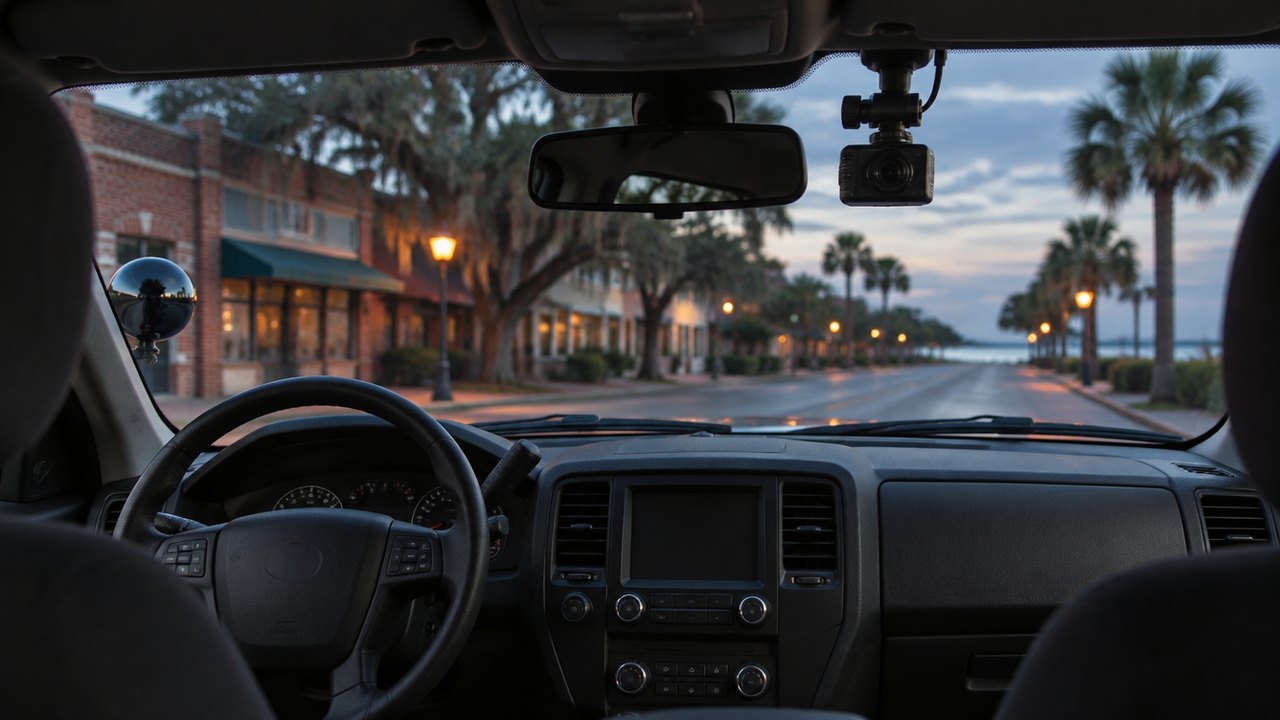
Body and dash cameras record police encounters. A plate reader does something different: it logs the plates of vehicles a patrol car passes. The records posted for Tuesday’s vote show the city would be paying for that capability, but they do not say whether it will be switched on, how long plate data would be kept or who could search it. The purchase is listed for approval without its own discussion slot.
The Fernandina Beach City Commission meets Tuesday, November 17, at 6 p.m. at City Hall, 204 Ash Street. Item 6.6 on the posted agenda is Resolution 2026-156, a five-year purchase agreement with Motorola Solutions for “body-worn cameras, in-car cameras, related hardware and software” at $622,745.82. It sits on the consent agenda, a list of 12 resolutions grouped under one heading. The city manager’s recommendation in the agenda packet is to adopt it. This is a proposal. Nothing has been approved.
The vote is scheduled one hour after a 5 p.m. organizational meeting where, according to that agenda, two commissioners, the mayor and the vice mayor take the oath of office.
What the police chief says the city is buying
In an October 16 memo in the packet, Police Chief Jeffrey Tambasco writes that the department has used body and in-car cameras since 2014 and began moving to newer models in 2024, a few at a time as it bought vehicles. He writes that refurbished older units have become scarce, that the body and car cameras work as a pair so old and new models cannot be mixed, and that the department “looked into multiple manufacturers and realized that it is more cost effective to stay with our current manufacturer.” The memo does not name the other manufacturers or give their prices.
The memo lists what would change for officers and for the footage:
- Cloud storage. Video would move from an in-house server to the vendor’s cloud. Officers now park near an upload antenna at the station and wait, “sometimes” more than an hour, the chief writes.
- Automatic paperwork. The system would link to the computer-aided dispatch system and fill in incident information. The memo says the upload “will also contain a narrative based on the interaction footage.”
- Live video. “During high-risk incidents, the cameras can be live streamed back to the command post.”
- A shared platform with the sheriff. The chief writes that the Nassau County Sheriff’s Office is moving from Panasonic to Motorola, which “will place both agencies on the same platform” and “enhance sharing capabilities.”
What the quote lists that the summary does not
The resolution’s Exhibit A is a Motorola quote dated June 1, 2026. Most of it is scanned images, so a text search of the 1,303-page packet does not find these lines. We read the price pages directly. They include:
- 25 V700 body cameras, with batteries and docks.
- 19 M500 in-car camera systems, at $93,015.07 for five years.
- 30 units of “M500 BASIC ALPR VAAS,” a five-year item under the heading “LPR Integrations and Parking,” at $800 each, or $24,000. ALPR stands for automated license plate recognition.
- “CommandCentral Aware,” at $24,654.23, with 75 “location devices,” 75 “video devices” and an integration for “mobile video streaming.”
- “CommandCentral DEMS Plus,” the evidence storage service, quantity 65, at $136,384.95, and “Responder Productivity Assist” for 65, listed as included.
- 30 Semtech AirLink XR60 5G routers at $47,494.80.
The quote’s own product description explains the plate-reading item: “M500 cameras use an on-device engine to provide immediate license plate recognition,” and data sent to the vendor’s mobile software “triggers hotlist alerts.” It says the design “allows for easy addition of more LPR cameras.” The same pages describe the M500 as “the first AI-enabled in-car video solution for law enforcement,” and the evidence software as offering AI transcription, AI-generated summaries and AI-assisted redaction.
The one-page staff summary, the resolution text and the chief’s memo do not mention license plate recognition. Those documents describe replacing cameras with “the latest version” and adding software that is “more technologically advanced.”
A product line on a quote is not proof the feature will be used. The records do not say whether plate reading would be turned on at delivery, on which vehicles, against which hotlists, or under what department policy. They also do not explain why the quote lists 30 plate-recognition units and 19 in-car camera systems.
How it would be paid for
The quote shows a list price of $996,529.46, less a 20% discount and a “technology upgrade discount,” for a total of $622,745.82. The payment schedule is $50,000 in year one and about $143,186 in each of the next four years. The quote’s terms state that the full contract price “is fully committed and identified, including all subsequent years of contracted services, if applicable.”
The resolution would pay the first $50,000 from the reserve of the Law Enforcement Recovery Fund and record the full $622,746 in the capital improvement fund as equipment bought with loan proceeds. Later payments would be budgeted from that fund’s principal and interest accounts, “subject to appropriation.”
The records show no separate city bid for this purchase. The resolution uses a “piggyback” on a Sourcewell cooperative contract, and a sole-source form dated October 28 recommends that “competitive procurement be waived,” checking one box as justification: “Continuity of product/services.”
Also on the consent list: an $86,195 fire drone
Item 6.5, Resolution 2026-155, is a three-year, sole-source agreement with BRINC Drones for the Fire Department: $20,000 on receipt, $38,196 due October 29, 2027, and $27,999 due October 29, 2028. The quote covers one “Responder” drone with a spotlight, a payload dropper, a parachute, spare batteries and a “Restube Automatic Rescue Kit,” plus the company’s “LiveOps” streaming and remote-operation software, with storage for the length of the contract.
The staff summary says the Fire Department would use it to size up fires and hazards, find people who need help, support search and rescue, assess storm damage and “document emergency scenes.” A city project form describes it as a “First Responder Drone with PFD and Narcan Delivery Capabilities.” PFD is the common abbreviation for a personal flotation device.
The vendor’s sole-source letter lists a thermal camera, 40x zoom, a loudspeaker and microphone, and a 42-minute flight time. It also says the software has an “integrated data and transparency dashboard, allowing the community to check and review drone operations.” The city records do not say whether Fernandina Beach would turn that public dashboard on.
What state law already requires
Section 316.0778, Florida Statutes, directs the Department of State, working with the Florida Department of Law Enforcement, to set a retention schedule for plate-reader images and data that “must establish a maximum period that the records may be retained.” Section 316.0777 makes plate-reader images and data that contain personal identifying information confidential and exempt from public records disclosure, while allowing criminal justice agencies to share them for official duties.
Those statutes set outer limits. They do not tell residents what Fernandina Beach’s own rules would be. This is also the second plate-reader question in Nassau County this fall. In August the sheriff’s office said a state order to remove readers from state-road rights-of-way applied to 34 of its Flock cameras, as we reported October 29. That order concerned fixed roadside cameras, not cameras inside patrol cars.
The Fix
Analysis and opinion. New cameras for a department that cannot get parts for its old ones are easy to defend, and the chief’s memo makes that case plainly. The problem is narrower. A capability that tracks vehicles is priced inside a 120-page scanned exhibit, absent from the one-page summary, and placed on the consent list. Four steps would fix that without delaying the cameras:
- Take item 6.6 off the consent list and give it its own discussion and vote. A $622,746, five-year commitment that adds new police software deserves one.
- Answer the plate-reader question on the record. Will the 30 ALPR units be activated? If the department does not intend to read plates, the $24,000 line can come out. If it does, say so before the vote.
- Publish the rules first. How long plate data is kept, which hotlists are loaded, who may search it, whether the sheriff’s office or outside databases can see it, and how searches are audited. The same goes for AI-written incident narratives: who reviews them, and are they labeled?
- Turn on the drone’s public dashboard and adopt a short written policy on when the fire drone flies and how long its video is stored.
If you want to weigh in
Item 5 on Tuesday’s agenda, before the consent vote, is “public comment regarding items not on the agenda or the consent agenda.” The agenda says a “Request to Speak” form is available on the counter at the entrance to the commission chambers and should be given to the city clerk, and that a three-minute limit may be imposed.
What remains unanswered
- Whether the department plans to use in-car plate recognition, and on how many vehicles.
- What retention period, hotlists, access rules and audit process would apply to plate data and to live-streamed video.
- Which other manufacturers the department compared, and at what prices.
- Whether the department already operates any plate readers. The records reviewed for this story do not say.
- Whether police would have access to the fire drone or its video.
Primary sources
- City of Fernandina Beach, City Commission Regular Meeting agenda, November 17, 2026, posted November 10, 2026: meeting time and place, consent items 6.5 and 6.6, public comment item 5 and speaker rules; checked November 14, 2026.
- City of Fernandina Beach, agenda packet for the November 17, 2026 regular meeting (1,303 pages), posted November 10, 2026. Resolution 2026-156 and staff summary, packet pages 339–341; Motorola quote, Exhibit A, pages 343–462, with price lines on pages 344–350, the in-car camera description on page 351, the plate-recognition description on page 382 and the evidence software description on page 437; police chief’s October 16 memo, pages 473–474; sole-source form dated October 28, page 475. Resolution 2026-155 and staff summary, pages 313–315; BRINC quote and payment schedule, pages 330–332; project form, page 334; sole-source form and vendor letter, pages 335–338. Checked November 14, 2026.
- City of Fernandina Beach, City Commission Organizational Meeting agenda, November 17, 2026, posted November 10, 2026: 5 p.m. start and oaths of office; checked November 14, 2026.
- Section 316.0778, Florida Statutes (2025): retention schedule for automated license plate recognition records; checked November 14, 2026.
- Section 316.0777, Florida Statutes (2025): confidentiality of plate-reader images and data, and sharing among criminal justice agencies; checked November 14, 2026.
- Amelia Undertow, October 29, 2026: sheriff’s announcement on 34 Flock cameras and the state removal order, with its primary sources.
Status: Both purchases are proposals on the November 17 consent agenda. Neither has been approved. Quantities and prices come from vendor quotes attached to the resolutions; the Motorola quote pages are scanned images that we read directly. No record reviewed says the plate-recognition feature will be activated. “The Fix” is this publication’s analysis and opinion.