800 Kids vs. Airplane Hangars: Who Are the Bullies, and What Are the Solutions?
The city never voted. A federal rule, an anonymous complaint and years of delay did the pushing, and the price everyone is choking on is money the city would pay to itself. Here is who did what, three loopholes worth a written answer, and five ways to find the missing $1.05 million to $1.75 million.
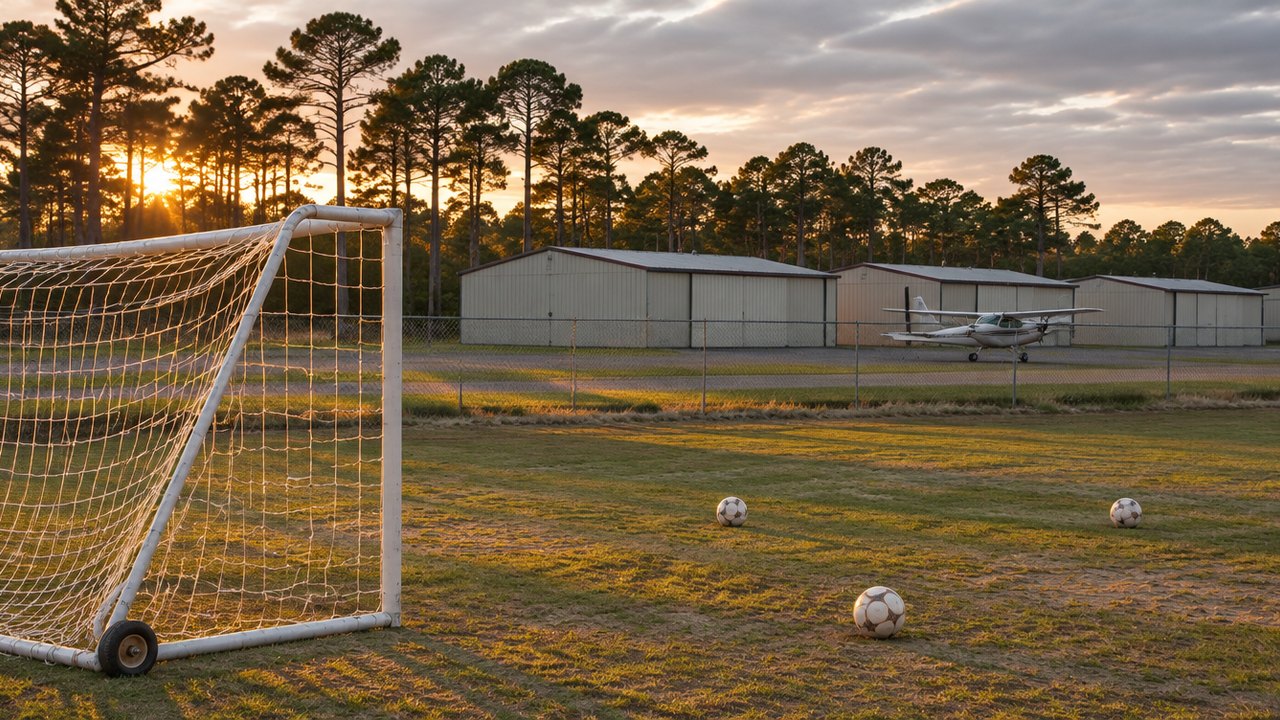
About 800 children play at Ybor Alvarez this season, according to the youth soccer club. The fields sit on land that belongs to the city’s airport. Federal rules say soccer stays only if the city pays the airport fair-market rent or buys the land at fair-market value. No vote has been taken and no closing date is set, but four of five commissioners have said they see no way to pay.
If you want one villain, this story will disappoint you. Nobody at City Hall woke up wanting to pave a kids’ soccer complex. What pushed 800 players to the edge is a chain: a federal rule, a complaint from someone the city has not named, years in which the city did not deal with it, and a commission that said no before it had the final price. Each link has a name, and each one can be pressed.
This analysis is built on the city’s video of the November 4 workshop, where the Ybor Alvarez item starts at about 1 hour 17 minutes, plus county records and the federal rules themselves. The opinions are ours and are labeled. The facts are linked.
First Coast News, Jacksonville’s ABC and NBC stations, spoke with players and parents at the fields on November 12.
Video: First Coast News (WJXX ABC25 / WTLV NBC12). Watch on YouTube.
First, what did not happen
The commission did not vote to give up the fields. November 4 was a workshop, a session for discussion and direction to staff. A statement from Commissioner and Mayor-elect Genece Minshew, published by First Coast News, says no vote was taken and that staff will return for direction once an appraisal review is finished.
What did happen: Minshew said she does not see a path forward for that kind of money after Amendment 3. Commissioner Joyce Tuten called it a service the city has to cut and a real loss to the community. A third commissioner agreed. Mayor James Antun, whose daughter plays there, said he saw no path either. Only Vice Mayor Darron Ayscue asked to see the final number and a payment plan first.
Who is doing the pushing
The rule. Airport Manager Nathan Coyle told commissioners the land was released to the city by the federal government in 1954 and later re-obligated as airport property. Using it for anything but aviation needs Federal Aviation Administration approval, and the airport has to be paid fair-market rent or fair-market value. The FAA’s own manual says rates for non-aviation use of airport land must be based on fair market value, with a few exceptions we get to below.
The complaint. Coyle said the city learned in May that a member of the public had filed a Part 13 complaint with the FAA about Ybor Alvarez. He did not name the person. Part 13 is the FAA’s informal complaint process; the formal version, Part 16, can end in penalties or lost grants, he said. The FAA asked the city for a voluntary corrective action plan within 60 days. Coyle did not give the date of that request, so the deadline is not in the public record we reviewed.
The delay. This did not sneak up on anyone. City staff told a joint city-county meeting in February 2025 that the airport’s T-hangar expansion was driving the issue. The county signed on to split a purchase and rebuild in September 2024. The Fernandina Observer reported in June that Coyle said the city stopped paying the airport for the fields about ten years ago and the FAA never followed up. At the workshop, the mayor said the original plan had the county’s $1.75 million covering half of a $3.5 million project, and that the commission’s firing of a city manager left no one moving it for nearly two years.
The demand. The airport has people waiting for hangars. The News-Leader reported a waiting list of 85 in 2023. Coyle told commissioners the FAA has signaled that releasing the land could be hard to approve if aviation demand at the airport is unmet.
The commission. Four commissioners said no to a range, $2.8 million to $3.5 million, before the review appraiser had produced the final number and without a side-by-side of what leaving will cost.
Does this make sense?
Here is the part that should bother every taxpayer, whether or not you have a kid in cleats. The city owns the airport. If the city buys the soccer land, it is the buyer and the seller. The money would leave the city’s general fund and land in the city’s airport fund, where federal rules say it must be used for the airport. It is not a check to Washington. It is the city moving money from one of its pockets to another, with a federal lock on the second pocket.
That does not make the price fake. The general fund is the pocket that pays for police, parks and streets, and Amendment 3 is about to shrink it. But it changes the question. The choice is not kids against a federal bill. It is how much city money gets steered to the airport, how fast, and on what terms.
And walking away is not free. The city’s fallback is to expand the Hickory Street fields, upgrade land it hopes to lease from the school board on Atlantic Avenue, and add lights elsewhere, according to Minshew’s statement and News4JAX. Nobody has put a price on that list in public. The city has also not published what new hangars on the soccer side would earn the airport each year. Without those two numbers, no one can honestly say which choice is cheaper.
Three loopholes worth a written answer
These come from reading the public rules. They are not legal advice, and the FAA and the city attorney get the final say. Each deserves an answer in writing before the city files its plan.
1. The community-use exception. The FAA’s compliance manual allows airport land to be used for community purposes at less than fair market value, and it names public parks and recreation facilities as acceptable uses. The catch is a list of six conditions, starting with the land not being needed for aviation. A hangar waiting list cuts against that. But the same section says that when land could earn more than minimal revenue, the rent can be set to roughly match what the airport could otherwise earn from it. That is a different number from an appraiser’s fair-market value, and it could be a lower one. Has the city asked the FAA to price a lease that way?
2. The park law Congress wrote. Federal law lets some airports keep recreational and park uses without collecting fair market value. It is narrow: it covers airport land bought with a federal grant before 1989, among other conditions. Coyle described Ybor Alvarez as surplus property the government released, which suggests it may not qualify. The city should say so in writing, with the deed, so families are not left wondering.
3. The park grants. City staff told the county in 2025 that the city accepted two grants in the late 1980s to develop this land, and that it was working with the Florida Department of Environmental Protection and the National Park Service to clear them. Coyle called them competing federal obligations. The city has not said publicly which grant program is involved. If it is the Land and Water Conservation Fund, federal rules say parkland built with that money cannot be converted to another use without National Park Service approval and replacement land of at least equal value and usefulness. If that applies here, hangars do not come free either: the city would owe the public replacement parkland. That one question could change the math.
Five ways to find the money
The gap is $1.05 million to $1.75 million after the county’s $1.75 million, as First Coast News calculated, before drainage and other improvements. The arithmetic below is ours.
1. Pay the airport over time. The city is on both sides of this sale, so it can ask the FAA to approve an installment purchase: the county’s $1.75 million down, and the rest paid to the airport fund over 20 years at a market interest rate. FAA policy bars airport loans to the city at below-market interest, which is why the rate has to be real. At 5 percent, the payment on $1.05 million is about $84,000 a year. On $1.75 million it is about $140,000. Compare that with fair-market rent, which city workshop materials put at roughly $300,000 a year, the Observer reported. Ayscue asked about payments. Nobody answered him.
2. A field fee that pays the note. First Coast News reported in March that the club serves about 800 children in each of its fall and spring seasons. A $50 facility fee per player per season raises about $80,000 a year. At $75 it is about $120,000. That alone covers most or all of the payment in option one, with scholarships for families who cannot pay. The users would be funding the fields, which answers the commissioner who noted that many players live outside the city.
3. A bigger county share. If most players really are county residents, that is an argument for the county to carry more of an island facility, not only to send island kids across the bridge. The county’s $1.75 million was set in 2024, before the latest appraisals. The county’s own plan treats parks as basic infrastructure, like roads and utilities. Ask the county commission to revisit the split.
4. Founders and naming rights. Spread across 800 players, the gap is about $1,300 to $2,200 per player, one time. Nobody should ask families for that. But 100 donors or sponsors at $10,000 is $1 million, and Nassau County is already weighing sponsor names on parks. A 90-day campaign with a public thermometer would show fast whether Ayscue’s “big private donor” exists.
5. Trade land instead of cash. The airport must receive fair value. It does not have to be money. Coyle mentioned a city-owned parcel north of the Parkway that is not airport property and was ruled out for fields. Could it, or another city parcel, be traded to the airport for the soccer acreage? The FAA would have to agree the trade is fair. Has anyone asked?
The slow option is a referendum on a small debt millage, which a commissioner raised at the workshop. It is at least two years away, and the city would owe rent while it waited.
The date that moved
Coyle said he planned to return November 17 with the final appraisal and a package asking whether to request the land’s release. The agenda for that meeting, as published and checked November 13, lists no Ybor Alvarez item. Minshew’s statement gives no date.
If you want to be heard
The commission meets Tuesday, November 17, at City Hall, 204 Ash Street. An organizational meeting is listed for 5 p.m. and the regular meeting for 6 p.m. The regular agenda includes public comment on items not on the agenda. Five questions to ask:
1. When is the plan due to the FAA, and will you vote before it is sent?
2. What is the final appraised value?
3. What does the transition plan cost, line by line?
4. Which grant program paid for these fields, and does it require replacement parkland?
5. Has the city asked the FAA about paying over time, a community-use lease, or a land trade?
Primary sources
- City of Fernandina Beach, City Commission Workshop video, November 4, 2026, item 2, Ybor Alvarez Sports Complex, from about 1:17:00 to 1:33:30: land history, FAA lease and release rules, 11.64 acres, appraisal range, Part 13 complaint, 60-day corrective action plan, release concerns, park grants, planned November 17 return, county’s $1.75 million, city-owned parcel, and commissioners’ comments; reviewed November 13, 2026.
- City of Fernandina Beach, City Commission Regular Meeting agenda, November 17, 2026; checked November 13, 2026.
- Nassau County Board of County Commissioners, joint meeting with the City of Fernandina Beach, minutes, February 6, 2025: late-1980s grants, state and National Park Service involvement, T-hangar expansion.
- Nassau County agenda item, Interlocal Agreement for Ybor Alvarez Sports Complex, September 18, 2024: county contribution and city Resolution 2024-162.
- Nassau County, Parks: county share of Ybor Alvarez and parks funding approach; checked November 13, 2026.
- FAA Order 5190.6C, Airport Compliance Manual, Chapter 17, dated February 20, 2026: fair market value for non-aviation use and the community-purposes exception (section 17.13).
- FAA Order 5190.6C, Chapter 3: surplus property and use of revenue for the airport.
- FAA Order 5190.6C, Chapter 5, and 14 CFR Part 16: informal and formal complaints.
- 49 U.S.C. 47107(v): community use of airport land.
- 36 CFR 59.3: conversion rules for Land and Water Conservation Fund parkland.
Other reporting cited
- First Coast News video and article via Yahoo, November 12, 2026: families at the fields, Minshew’s statement, enrollment, the funding gap.
- News4JAX, November 12, 2026: which commissioners made which remarks, and the city’s other field plans.
- Fernandina Observer, June 2026 and February 2026: lapsed payments and estimated annual rent.
- News-Leader, 2023: hangar waiting list.
Status: This is analysis. No vote has been taken and no closing date is set. The $2.8 million to $3.5 million range is preliminary. The loopholes and funding ideas are questions for the city and the FAA, not established options; none has been approved or, as far as the public record shows, formally requested. The grant program behind the fields has not been confirmed. One commissioner is described without a name because the video alone did not confirm the speaker. Payment figures are our arithmetic at an assumed 5 percent over 20 years.